MEDIA INQUIRIES

Oops! Something went wrong while submitting the form.
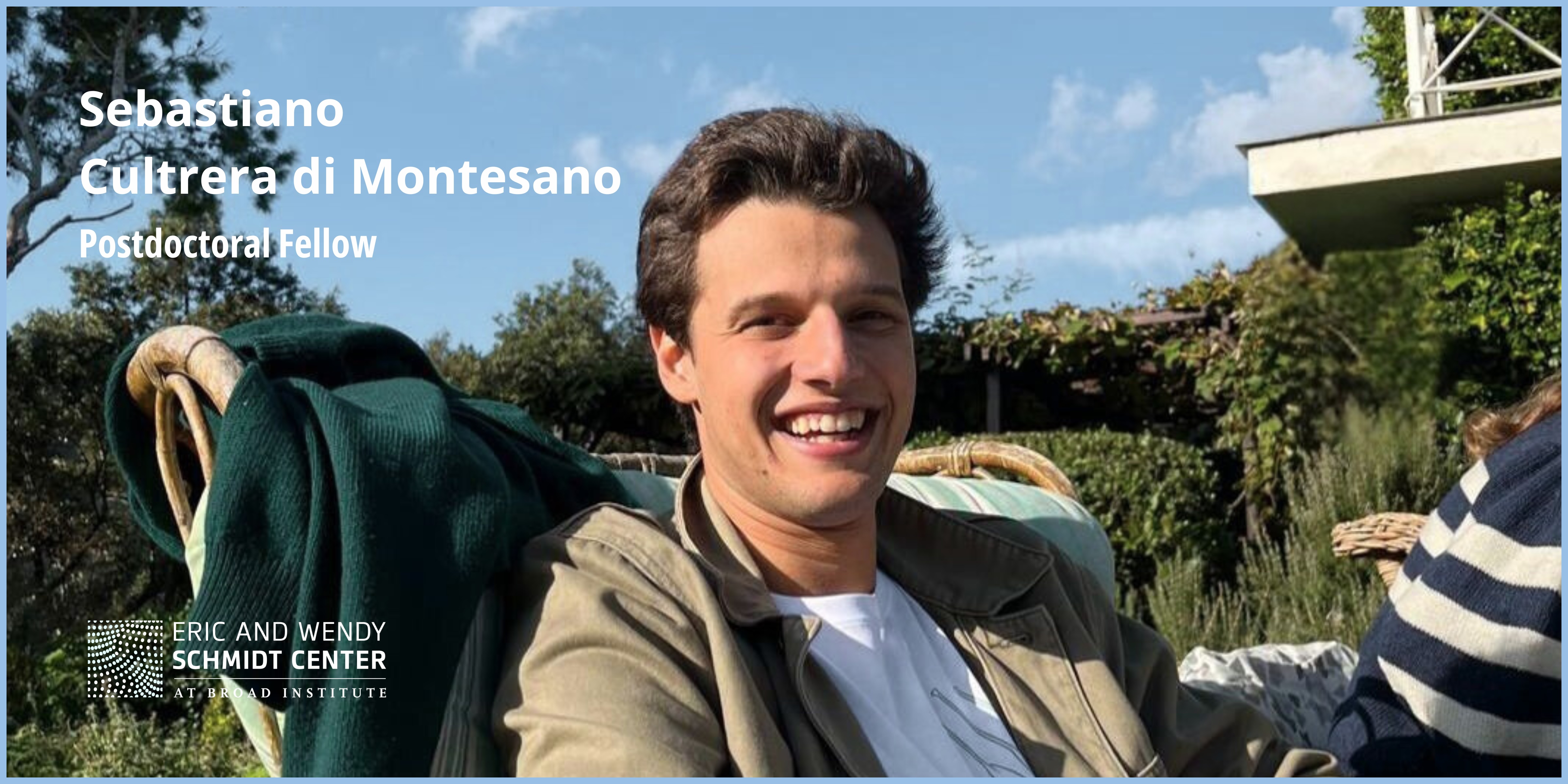
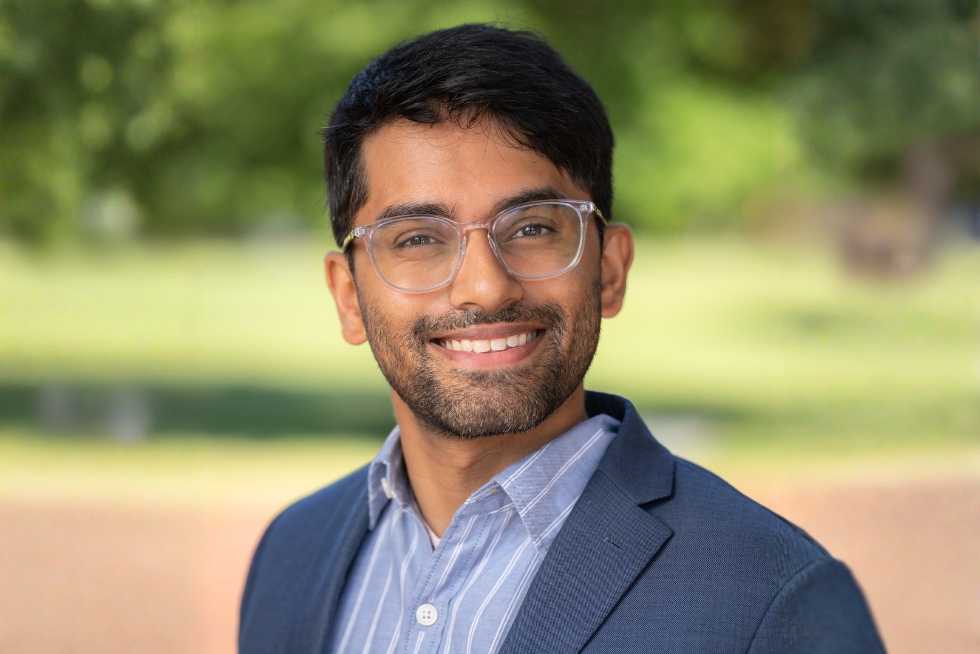
When Sebastiano Cultrera di Montesano arrived at the Eric and Wendy Schmidt Center at the Broad Institute of MIT and Harvard in 2024, he brought with him a background in mathematics — and a willingness to learn the language of biology.
“He came as mostly a pure math guy,” says Peter Winter, Principal Investigator and Co-Director of the Project Ex Vivo group at the Broad Institute. “He would sit in lab meetings, listening to the biological problems we were dealing with. And then once he learned the language a little bit, he started offering ideas.”
Seb, a postdoctoral fellow at the Schmidt Center, completed his PhD in computational topology and geometry from the Institute of Science and Technology Austria (ISTA) under the supervision of Herbert Edelsbrunner, focusing on uncovering structure in complex data.

“I was always fascinated by the biomedical sciences,” Seb says. “I thought at some point I would switch from mathematics to biology, but the math kept being intriguing.” After a biotech internship in Paris near the end of his PhD, he began thinking about combining the two. “I remember being captivated by it — developing new mathematical tools for biological questions.”
When he learned about the Schmidt Center, which aims to build a two-way street between machine learning and biology, the fit felt natural. “The Schmidt Center put the emphasis on finding researchers with strong mathematical foundations without requiring deep prior experience in biology, to help uncover biological problems. There aren’t too many places like that.” After visiting the Broad and meeting fellows and faculty, he decided to make the leap across the Atlantic.
Today, his work sits squarely at the intersection of mathematics, AI, and biology. “I thought this would be an incredible place to continue my research.”
“My background is really about structure,” Seb says. “Computational geometry and topology are about asking: what is the shape inside a dataset? How is it organized?”
When he arrived at the Broad, he spent his first weeks talking to researchers across groups.
“It was an adjustment at first,” he admits. “You’re not getting ‘actual work’ done — you’re mostly listening and trying to understand what questions might be interesting.”
One question kept coming back to him:
“When are experiments that biologists run actually predictable? And when do we really need to do them to learn something new?”
He explains it with a simple analogy:
“As humans, there are a lot of experiments in life that we don’t do. If I take a glass of water and throw it on the floor and it breaks, I don’t need to take a mug and throw it on the floor to see whether it will break. We have some understanding of the physical world that lets us decide what to test and what not to test — because we can’t possibly try everything. The floor and broken glass would be a mess!”
He became interested in whether machine learning models could develop a similar intuition for certain biological systems — predicting outcomes in advance and perhaps helping guide which experiments are worth running.
In his recent paper, “Improving atlas-scale single-cell annotation models with hierarchical cross-entropy loss” (Sebastiano Cultrera di Montesano, Davide D’Ascenzo, Srivatsan Raghavan, Ava P. Amini, Peter S. Winter, & Lorin Crawford), Seb focused on cell annotation in single-cell RNA sequencing data.
“The task is: if I’m given gene expression data for a cell, can I categorize it into a cell type?” he explains. “Macrophage, T cell, and so on.”
But he noticed something subtle.
“These labels aren’t just a flat list. They’re organized like a tree.”
He offers another analogy:
“If I’m trying to predict something like cat, dog, elephant, or mouse — that’s a flat list. But if I’m trying to predict golden retriever, poodle, or tabby cat, those are at different levels of granularity. Golden retriever is a kind of dog, which is a kind of animal. So the labels have structure.”
Cell types work the same way. There are broad categories like immune cells, more specific ones like T cells, and then even more granular subtypes.
“Most models treat these labels as independent,” Seb says. “If the model predicts something slightly more specific — say CD-positive T cell instead of just T cell — it’s considered completely wrong. But biologically, that’s not entirely reasonable.”
So instead of building a brand-new model, Seb modified the training objective itself.
“I didn’t invent a new architecture,” he says. “I took existing methods and tweaked them so they respect the geometry of the label space.”
The resulting hierarchical cross-entropy loss improved performance across multiple model classes — and, importantly, applies to any hierarchical classification task, not just cell types.
Lorin Crawford, Principal Researcher at Microsoft Research who co-leads Project Ex Vivo, says the elegance stood out immediately. “The idea felt so simple. It was like, ‘Why hasn’t anyone already done this?’ That’s very much Seb — coming up with something that seems obvious in hindsight.”
Seb first met Lorin while visiting the Broad during his PhD, after reaching out to discuss topology. When he later joined the Schmidt Center, the collaboration deepened naturally.
“The timing was right because Project Ex Vivo’s efforts are similar in spirit to the Schmidt Center – trying to put together researchers of different backgrounds, both biologists and computer scientists,” says Seb.
“It’s been a really wonderful situation,” says Peter. “Seb embodies what cross-disciplinary science at the Broad is about. He brought his mathematical understanding, sat with biologists for a while, didn’t become a biologist — but learned enough to tackle the problem differently.”
Peter recalls that the hierarchical insight emerged after Seb had spent time absorbing how biologists talk about cell types. “He realized life isn’t organized in a flat linear context — it’s hierarchical. And if you teach a model that structure, it performs better.”
For Lorin, Seb’s growth mindset has been equally important. “He’s always willing to put himself in a place where he might feel like a fish out of water,” he says. “That humility and eagerness to learn allows him to grow incredibly fast.”
Seb emphasizes the mentorship environment. “They were open to me working on what I found interesting and were very supportive — even when ideas didn’t work. In science, you have many ideas that fail before one works. Seeing how mentors react when things don’t work tells you a lot.”
Lorin and Peter both agree that Seb’s collaboration with Project Ex Vivo is a great model for future postdoctoral fellows at the Schmidt Center who want to work with them, with the freedom to try new ideas, utilizing the diversity of skill sets that the group has.
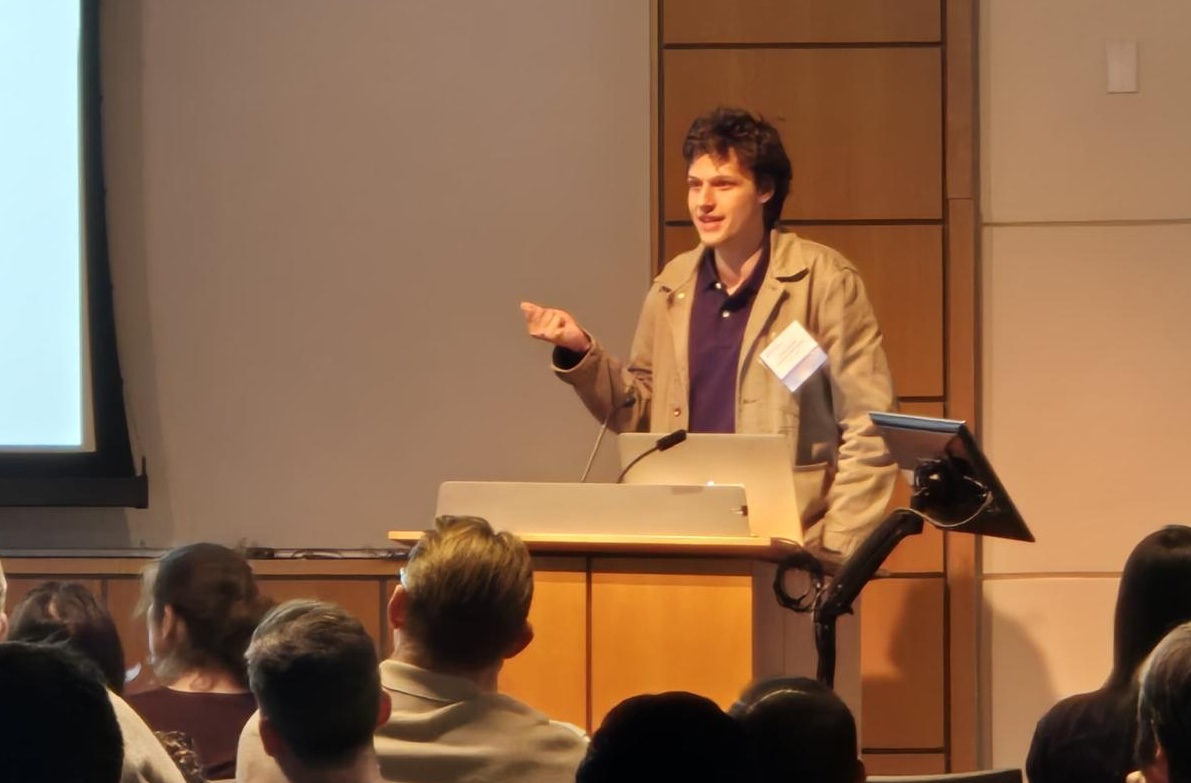
Seb is now excited to think about evaluation — how do we rigorously compare AI systems in biology?
“In images or text, you can often tell when something looks wrong,” he says. “But if a model predicts the outcome of a biological experiment, it’s much harder to have that immediate intuition.”
He’s interested in defining meaningful mathematical metrics to compare models, especially as new ones are released rapidly.
“In the end, we’re comparing sets of numbers,” he says. “The question is: what’s a rigorous and interesting way to do that?”
Long term, he’s also thinking about efficiency.
“I’m interested in making these AI models more efficient, from a cost or energy perspective,” he says. “That matters in biology, but also more broadly as AI becomes part of everyday life.”
“Incredibly rewarding,” Seb says. “Having fellows with varied backgrounds in applied mathematics, computer science, ML, and computational biology on the same floor makes the coffee chats much more interesting.”
He especially values the weekly group meetings at the Schmidt Center.
“You get challenged by people who think about computational methods from different angles,” he says. “If you stay in one group and you’re the one computational expert on a topic, it’s harder to get that kind of feedback. Here, you have people approaching related problems from different perspectives, and that’s incredibly productive.”
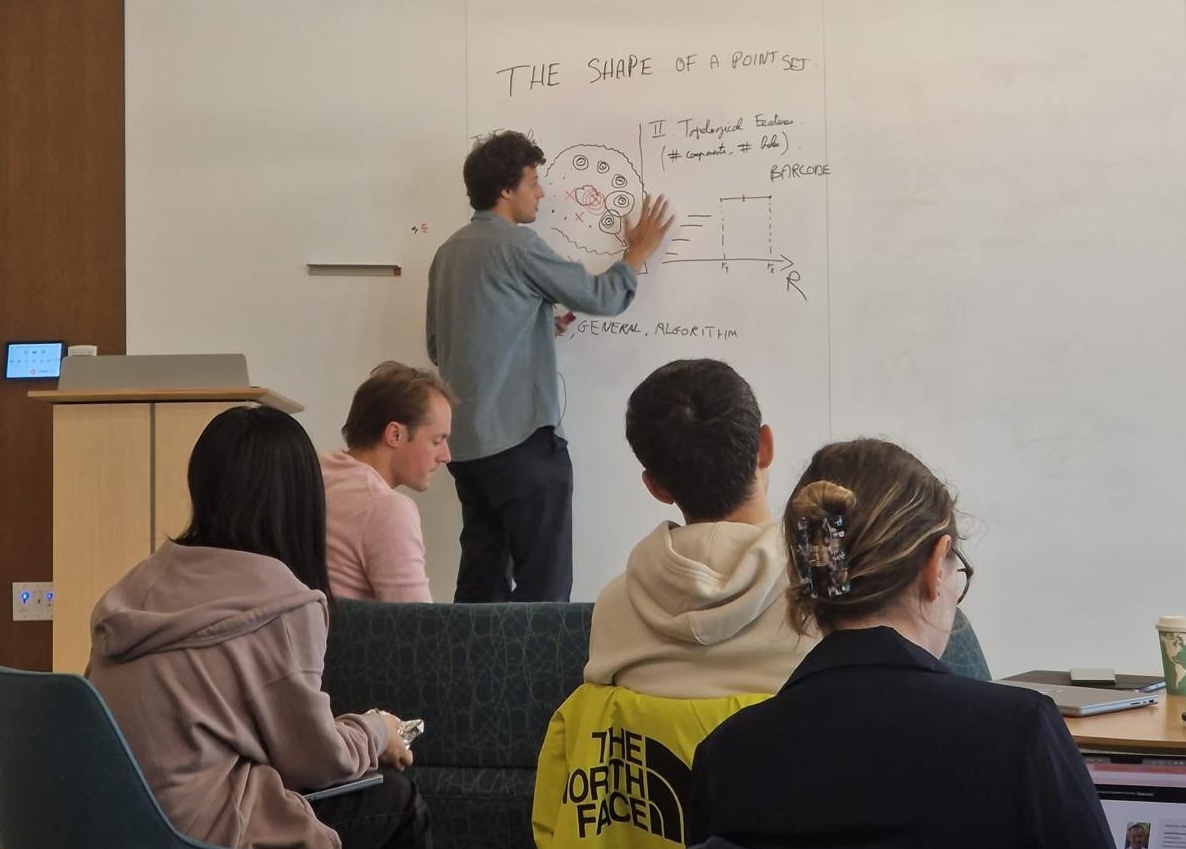
Beyond the Schmidt Center, Seb is also part of the Models, Inference & Algorithms (MIA) steering committee — a seminar series that brings together biologists and machine learning researchers, which he was following even before he joined the Broad.
“MIA was something I really enjoyed as a listener,” he says. “I particularly liked the primers, where someone takes the time to slowly dig into the important details of an algorithm. Coming from a different field, that was incredibly valuable for me.”
After joining the Broad, he became involved in organizing seminars and inviting speakers.
“It’s been a very fun and energizing experience,” he says. “You learn from the speakers, from their students and postdocs — and it also feels like a way to give back to the community.” (Learn more about Seb’s role and thoughts on MIA in our retrospective video – MIA: 10 Years of Models, Inference & Algorithms (MIA) at Broad Institute.)
Together, these spaces — the Schmidt Center, Project Ex Vivo, and MIA — have given Seb what he values most: a diverse intellectual environment where mathematical thinking and biological questions meet.

“If you hear about a project that genuinely interests you, go after it,” Seb says. “Research can feel daunting because you’re left with your own ideas. But that’s also what makes it exciting.”
He encourages students to try research early and trust their curiosity.
“Trends come and go,” he says. “It’s better to follow what you actually find fun.”
Sports have always been central to Seb’s life. He grew up playing basketball and now enjoys racket sports like tennis and paddle. As a first-time resident of the U.S., he’s also been exploring New England and hopes to see more of the United States.